Klara Koch · 16 October 2026
Shifting Funeral Customs and Their Mark on Container Shapes in Early Eurasian Settlements
Early Eurasian settlements from the Neolithic through the Bronze Age reveal patterns in how communities handled the dead, and container shapes adapted accordingly as practices evolved. Settlements across Anatolia, the Pontic-Caspian steppe, and parts of Central Asia left behind vessels that shifted from wide-mouthed storage jars to more specialized forms suited for holding remains after cremation or secondary processing became common. Data from stratified sites show these changes aligned with broader transitions in ritual rather than isolated stylistic preferences.
Initial Burial Container Forms in Neolithic Contexts
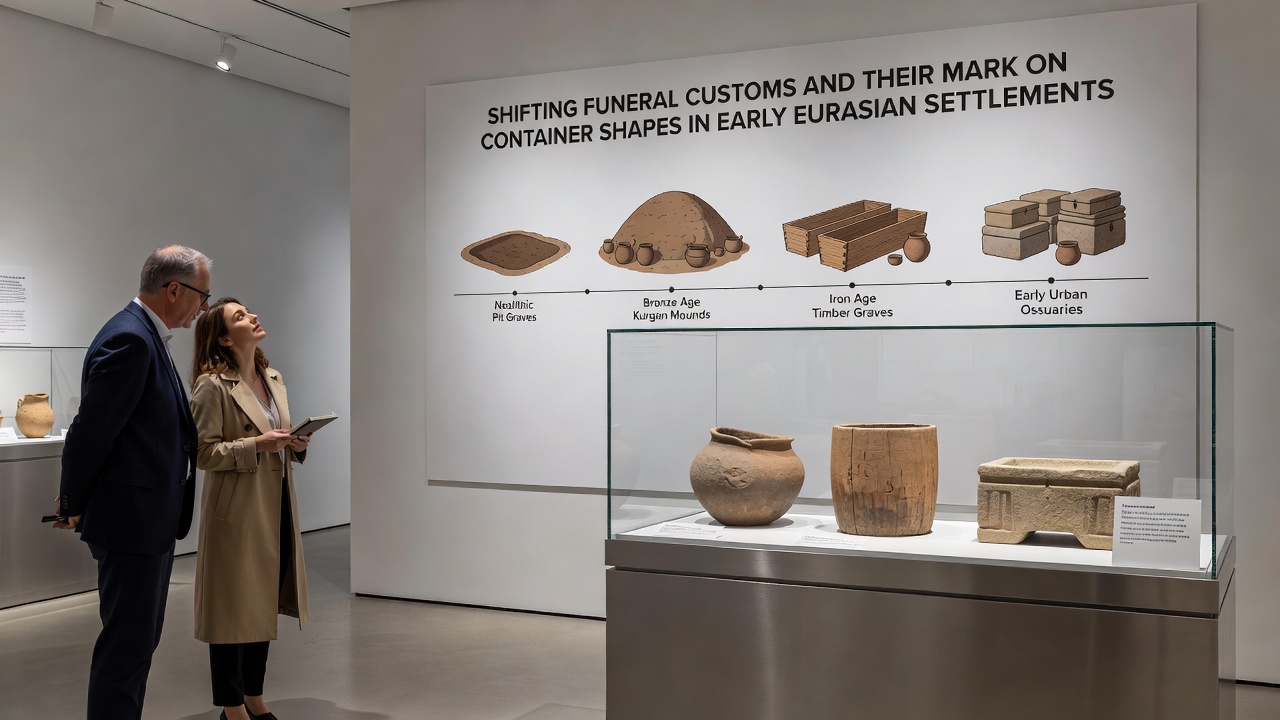
Communities in the earliest settled villages often placed flexed bodies directly into pits or simple pits lined with clay, yet when containers appeared they took the shape of large, open bowls or truncated jars that accommodated the crouched position without requiring disassembly. At sites dated between 7000 and 5500 BCE, these vessels featured flat bases and straight or slightly flaring walls, allowing easy insertion of the body and subsequent covering with lids or stones. Such shapes reflected a preference for primary inhumation where the container served mainly as a protective shell rather than a vessel for transformed remains.
Transition Toward Cremation and Secondary Burial
By the late Neolithic and into the Chalcolithic, evidence points to increased instances of cremation in certain regions, prompting a move away from wide containers toward narrower-necked jars that could hold collected bone fragments after the body had been burned on pyres. This adjustment reduced the internal volume needed while maintaining stability when the vessel was placed upright in a grave cut. Researchers examining assemblages from the northern Caucasus and western Anatolia note that rim diameters decreased while shoulder angles sharpened, creating forms that minimized spillage during transport from pyre to burial location.
Regional Adaptations Across Eurasian Zones
In the steppe zones, mobile pastoralist groups introduced portable cremation containers with rounded bottoms and constricted openings that could be carried on carts or packed with other goods. These differed from the flat-based examples found farther west, where permanent village structures allowed heavier, more stable vessels. Data compiled by teams at the Max Planck Institute for the Science of Human History indicate that shoulder-to-neck ratios narrowed progressively between 4000 and 2500 BCE in areas experiencing both population movement and ritual change. Meanwhile, communities along the Danube corridor retained wider forms longer, consistent with continued emphasis on primary burial before adopting elements of steppe practice.
Technological and Ritual Drivers of Shape Modification
Potters responded to new requirements by altering coil-building techniques and introducing interior smoothing to prevent bone fragments from catching on rough surfaces. Kiln temperatures rose in tandem with these modifications, producing harder fabrics that withstood repeated handling during multi-stage funeral sequences. Observers note that vessels intended for cremated remains frequently display reduced decoration on the lower body, since that portion remained buried and unseen, while upper sections received more attention to signal status or lineage. Such differentiation appears consistently in grave inventories from both settled and semi-nomadic contexts.
Evidence from Recent Fieldwork
Excavations conducted through 2025 and presented in October 2026 at the Eurasian Archaeology Conference in Almaty documented a cluster of mid-third millennium BCE graves in the eastern Caspian region where container profiles shifted abruptly from ovoid to biconical within a single generation. Associated radiocarbon sequences place this change alongside the appearance of new pyre structures and the first consistent recovery of calcined bone inside sealed vessels. The finds align with parallel developments farther west, suggesting the spread of secondary burial protocols rather than independent local invention.
Conclusion
Container morphology in early Eurasian settlements tracked the move from primary flexed inhumation to cremation and secondary deposition with measurable consistency. Rim constriction, base rounding, and fabric hardening each correspond to specific stages in the funeral process, while regional differences reflect the pace at which new customs arrived. Continued analysis of vessel metrics alongside skeletal and residue data continues to clarify these linkages without reliance on assumptions about belief systems.